
In the evolving landscape of non-USD stablecoins, the recent minting of EURW on Hedera mainnet marks a pivotal moment for euro-pegged assets. Issued by Newrails, an EU-licensed Electronic Money Institution (EMI), this MiCA compliant euro stablecoin promises 1: 1 backing with euro reserves while eyeing seamless SEPA integration. As investors seek diversification beyond USD dominance, EURW on Hedera positions itself as a regulated bridge between traditional finance and blockchain efficiency.

Hedera's hashgraph consensus offers low-cost, high-throughput transactions, ideal for stablecoin operations that demand reliability. Sources from Reddit's r/Hedera and X confirm the mainnet deployment, highlighting EURW as an extension of Newrails' off-chain euro issuance onto blockchain rails. This move aligns with broader trends in the euro stablecoin Hedera space, where regulatory clarity under MiCA accelerates adoption.
EURW's Mainnet Milestone and Hedera Synergy
The announcement of Newrails EURW has generated buzz, with community posts detailing its launch as a fully regulated EU regulated stablecoin. Each token represents one euro held in reserves, managed under stringent oversight. Hedera's ecosystem, known for enterprise-grade performance, supports this with sub-second finality and predictable fees, reducing frictions for payments and DeFi applications.

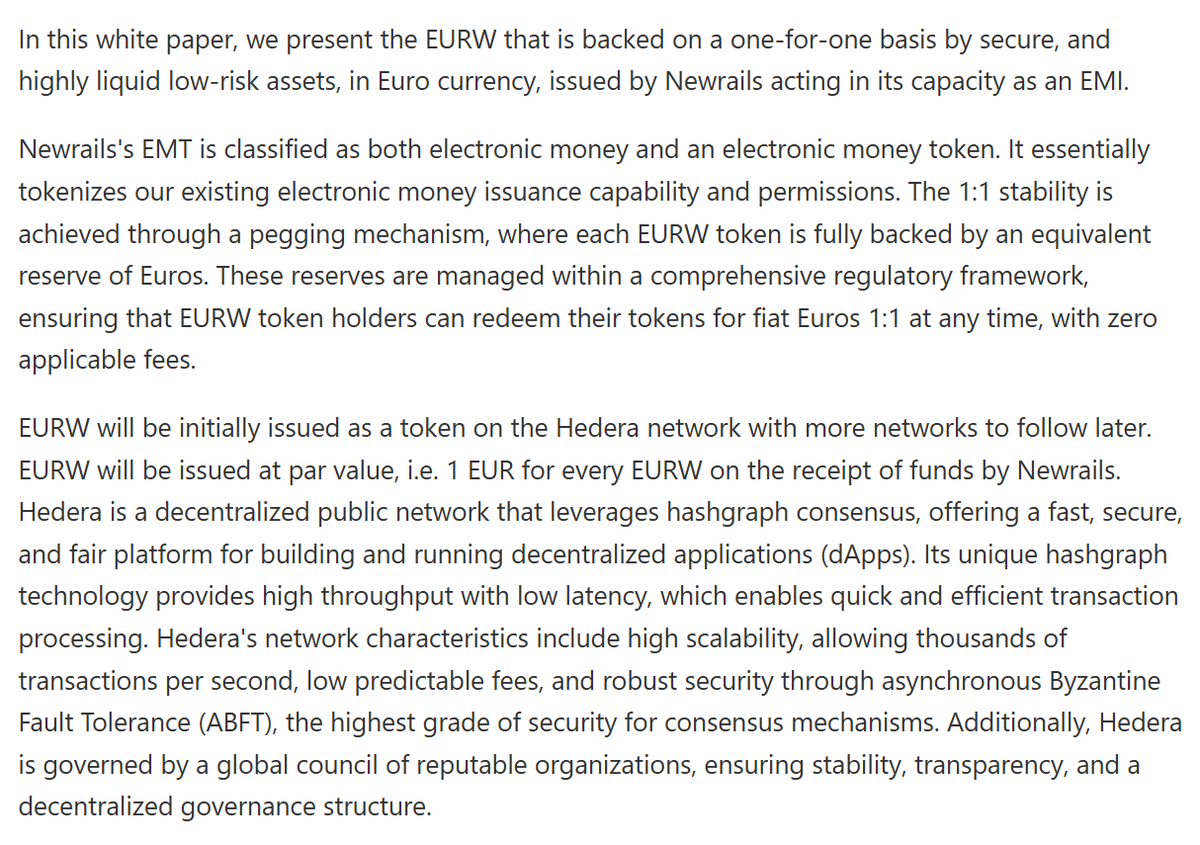
Unlike speculative tokens, EURW leverages Hedera's proof-of-stake mechanics to ensure scalability. Early data from Utila's 2026 Euro Stablecoin Landscape report underscores rising issuance among nine MiCA-compliant peers, yet EURW distinguishes itself through Hedera's carbon-negative certification and governance by councils like Google and IBM. This setup appeals to institutions wary of volatility in other networks.
MiCA Framework: Elevating EURW's Credibility
MiCA, the EU's Markets in Crypto-Assets regulation, imposes rigorous standards on stablecoin issuers, mandating 1: 1 liquid asset reserves and transparent disclosures. For MiCA compliant euro stablecoin like EURW, this translates to real-time reporting on composition, custody, and redemption processes. Oxford Law Blogs note the 'MiCA moment' pressures issuers to prioritize stability, a bar EURW clears via its EMI license.
Compliance isn't mere checkbox; it fosters trust. The ECB observes stablecoins as on-ramps to crypto, minimizing fiat conversions. EURW builds on this by embedding regulatory guardrails from inception, potentially outpacing non-compliant rivals. Digital Watch Observatory highlights how such tokens slash costs and boost speeds across the EEA, with MiCA ensuring redeemability at par value.

Reserves Breakdown: Fortified 1: 1 Backing
At EURW's core lies its reserve mechanism: euros deposited in segregated accounts at regulated custodians, audited periodically to verify parity. Newrails' framework mirrors established players like Banking Circle's EURI, but Hedera deployment adds programmable efficiency. MiCA demands high-quality assets - cash, equivalents, or short-term securities - shielding holders from depegging risks seen in past USD incidents.
Transparency reports, as required, will detail reserve flows, counterparty risks, and stress tests. This data-driven approach empowers users; for instance, Utila's tracking reveals transaction volumes surging for compliant euro stables. In my view, EURW's reserves position it for cross-border utility, especially as consortia of EU banks explore similar MiCAR paths per Finextra insights. Hedera's native tokenization tools further secure these holdings against unauthorized mints.
Looking at peers, Schuman Financial's EURØP on XRP Ledger and Monerium's EURe on Cosmos employ KPMG audits and SEPA links, yet EURW's Hedera choice prioritizes throughput for high-volume use cases. This reserve rigor, combined with MiCA, mitigates systemic risks, making SEPA stablecoin integration a logical next layer for frictionless euro flows.
Newrails envisions EURW bridging on-chain liquidity with SEPA's vast infrastructure, enabling instant fiat on-ramps without intermediaries. SEPA processes over 50 billion transactions annually at low cost, and tokenizing euros via EURW could turbocharge this for cross-border crypto settlements. Hedera's speed aligns perfectly, processing thousands of TPS while keeping fees under €0.0001 per transaction.
SEPA Integration: Unlocking Everyday Utility
SEPA integration stands as EURW's killer feature, allowing holders to redeem tokens directly into bank accounts across 36 EEA countries. Unlike siloed blockchain payments, this hybrid model leverages Newrails' EMI status for compliant fiat conversions. Monerium's EURe demonstrates the playbook: SEPA credits hit accounts in seconds post-burn, a model EURW replicates on Hedera for superior scalability.
Practically, users deposit euros via SEPA, mint EURW, deploy in DeFi or payments, then burn for instant redemption. This eliminates FX risks and conversion fees plaguing USD stables in Europe. ECB data shows euro stablecoins filling gaps in traditional rails, with volumes up despite small market share. For traders, euro stablecoin Hedera deployment means hedging euro exposure without leaving blockchain, a boon amid ECB rate shifts.
Comparison of MiCA-Compliant Euro Stablecoins
| Chain | Reserves/Audits | SEPA Integration | Key Regulator |
|---|---|---|---|
| Hedera (EURW) | 1:1 euro-backed Electronic Money Token; reserves held under regulated framework | Not specified | EU licensed EMI (Newrails); MiCA-compliant |
| Banking Circle (EURI) | Fully euro-backed | Not specified | MiCA (Banking Circle) |
| XRP Ledger (EURØP) | Fully euro-backed; regularly audited by KPMG; safeguarded at Société Générale and other institutions | Not specified | ACPR (French Prudential Supervision and Resolution Authority) (Schuman Financial) |
| Cosmos (Noble) (EURe) | Fully collateralized by euro deposits | Integrated with SEPA for instant euro transfers between on-chain and bank accounts | MiCA-approved (Monerium) |
| Multi-chain (EURC) | Held and managed by leading financial institutions; transparent reserves | Not specified | MiCA compliant (Circle EEA) |
Institutional appetite grows; Finextra reports nine EU banks consortium building MiCAR euro stables, signaling mainstream pivot. EURW's edge? Hedera's council governance ensures no single-point failures, vital for reserve custodians. I see this as disciplined risk management: MiCA's 1: 1 mandates plus Hedera's finality crush algorithmic pretenders.
Market Trends: Positioning EURW for 2026 Growth
Utila's 2026 report tracks nine compliant euro stables, revealing issuance spikes tied to MiCA deadlines. Transaction activity favors regulated EMTs, with EURW entering at an opportune juncture. Oxford insights warn of 'racing against time, ' yet compliant issuers like Newrails thrive on mandated disclosures, from reserve liquidity to redemption windows.
Cross-jurisdictional potential intrigues: inhouse-legal. eu posits MiCAR EMTs could gain US nod if rules align, opening USD-EUR arbitrage. Stablecoins as ECB-noted on-ramps gain traction, slashing repeated fiat conversions for traders. Digital Watch Observatory pegs MiCA tokens as EEA payment disruptors, cutting costs 80% versus cards. EURW, with Hedera's ESG creds, targets this: carbon-negative ops appeal to sustainable funds eyeing EU regulated stablecoins.
Peer benchmarking sharpens the picture. Circle's EURC boasts deep liquidity via global exchanges, but lacks Hedera's native throughput. Schuman's EURØP integrates Société Générale custody, audited by KPMG, yet XRP's history invites scrutiny. Banking Circle's EURI prioritizes regulation, mirroring EURW's EMI backbone. Hedera's predictability positions EURW for high-frequency apps like remittances, where SEPA shines.
Adoption hinges on liquidity bootstraps: expect DEX listings and wallet integrations soon. Early Reddit buzz in r/Hedera underscores community buy-in, with X threads dissecting 1: 1 mechanics. As euro stables mature, EURW exemplifies how non-USD pegs diversify portfolios, hedging USD-centric risks amid global macro flux.
Hedera's tooling, from token service to smart contracts, fortifies EURW against exploits, while MiCA's stress tests validate reserves under duress. Investors should monitor attestation reports; transparent flows build conviction. This regulated euro on-chain heralds efficient, compliant global payments, reshaping non-USD stablecoin dynamics with data-backed precision.




No comments yet. Be the first to share your thoughts!