
China’s Crackdown on Offshore CNY Stablecoins: Investor Risks and Alternatives in 2026

In early February 2026, China’s regulators delivered a stark message to the crypto world: offshore yuan-pegged stablecoins are now firmly off-limits without explicit approval. The People’s Bank of China (PBoC), alongside nine other agencies, issued a joint notice on February 6 that prohibits unapproved issuance of CNY-linked stablecoins both onshore and offshore. This escalation in CNY stablecoin regulation builds on prior measures, classifying most real-world asset (RWA) tokenization as illegal and targeting intermediary services that facilitate these activities. For investors who viewed yuan stablecoins as a bridge between traditional finance and DeFi, this represents a seismic shift, amplifying risks around capital controls and asset stability.


The notice explicitly bars domestic entities from issuing digital tokens overseas and extends scrutiny to foreign entities handling yuan-pegged assets backed by onshore holdings. This China offshore stablecoins ban isn’t mere rhetoric; it introduces “joint liability, ” holding tech firms, marketers, and payment providers accountable for violations. Drawing from 2025’s declaration that RWA tokenization constitutes illegal financial activity, Beijing is doubling down to safeguard systemic stability and curb unauthorized capital outflows. In my view, this move underscores China’s strategic pivot: prioritizing the digital yuan’s controlled rollout over decentralized alternatives.
The Evolving Timeline of Chinese Yuan Crypto Restrictions
Understanding the context requires tracing this regulatory arc. Since the 2021 blanket ban on crypto trading and mining, China has methodically tightened its grip. The 2025 crackdown targeted RWA efforts, deeming them illicit fundraising. Now, in 2026, the focus sharpens on unapproved CNY stablecoins, with the PBoC leading a multi-agency effort to vet any tokenization involving onshore assets. Sources like Reuters and Bloomberg highlight how this vets offshore issuances, potentially disrupting global DeFi liquidity pools reliant on yuan exposure.
Investor Risks Amplified in a Post-Notice Landscape
Holding offshore CNY stablecoins today carries heightened perils. First, depegging risks surge as issuers face compliance pressures; without onshore reserves or approvals, redemptions could falter amid frozen banking channels. Legal repercussions loom for Chinese nationals or firms involved, including asset freezes or criminal probes under joint liability. Portfolio managers like myself advise immediate assessment: exposure to these assets could trigger sharp devaluations, especially if exchanges delist them preemptively.
Moreover, this ban ripples through global markets. DeFi protocols integrated with CNY pairs may see liquidity evaporate, inflating slippage for traders. For diversified investors, the broader implication is clear: over-reliance on any single-currency stablecoin invites jurisdiction-specific shocks. China’s actions reinforce why non-USD stablecoins 2026 demand scrutiny, particularly those pegged to euro and yen for geographic diversification.
Strategic Pivot: Top Non-CNY Alternatives for Resilience
As yuan options constrict, savvy investors are eyeing EUR and JPY-pegged stablecoins for ballast. These assets offer exposure to robust economies outside U. S. dollar dominance and China’s orbit, enhancing portfolio hedging against Chinese yuan crypto restrictions. Prioritizing liquidity, issuer credibility, and on-chain depth, here are the standout contenders reshaping non-USD stablecoin strategies.
Leading the pack is EURT from Tether, a euro-backed stablecoin with deep liquidity across major DEXs and CEXs. Its reserves, audited and diversified in Eurozone treasuries, provide a reliable peg amid volatility. Close behind, EURC by Circle leverages the USDC issuer’s transparency, appealing to institutions seeking compliant euro exposure without onshore risks.
On the yen front, JPYC from JPYC Inc. stands out for its Japan-regulated framework, integrating seamlessly with local payment rails. Similarly, GYEN by GMO Trust benefits from GMO’s financial pedigree, maintaining a tight peg through yen-denominated reserves. Rounding out the top five, EURe from Monerium differentiates with its EU MiCA compliance, positioning it as a forward-looking choice for regulated DeFi participation.
These selections aren’t arbitrary; they’re vetted for their market cap, trading volume, and resilience in turbulent times. EURT, for instance, mirrors Tether’s battle-tested model but swaps dollar reserves for euro equivalents, trading at a premium on platforms like Uniswap with over $50 million in daily volume as of early 2026. Its transparency reports, issued quarterly, instill confidence, making it ideal for traders hedging against Chinese yuan crypto restrictions.
Top 5 Non-CNY Stablecoin Alternatives
-

#1 EURT (Tether): Tether’s euro-pegged stablecoin, backed 1:1 by EUR reserves. Liquidity: Strong on Ethereum, Tron, and DEXes like Uniswap. Regulatory status: Operates under Tether’s global framework amid ongoing scrutiny. Diversification benefits: Provides EUR exposure for hedging CNY volatility in 2026 portfolios.
-
#2 EURC (Circle): Circle’s regulated euro stablecoin, fully reserved and transparent. Liquidity: High on Ethereum, Solana, and CEXes. Regulatory status: Compliant with EU MiCA and US frameworks. Diversification benefits: Reliable EUR peg for strategic diversification away from CNY risks.
-
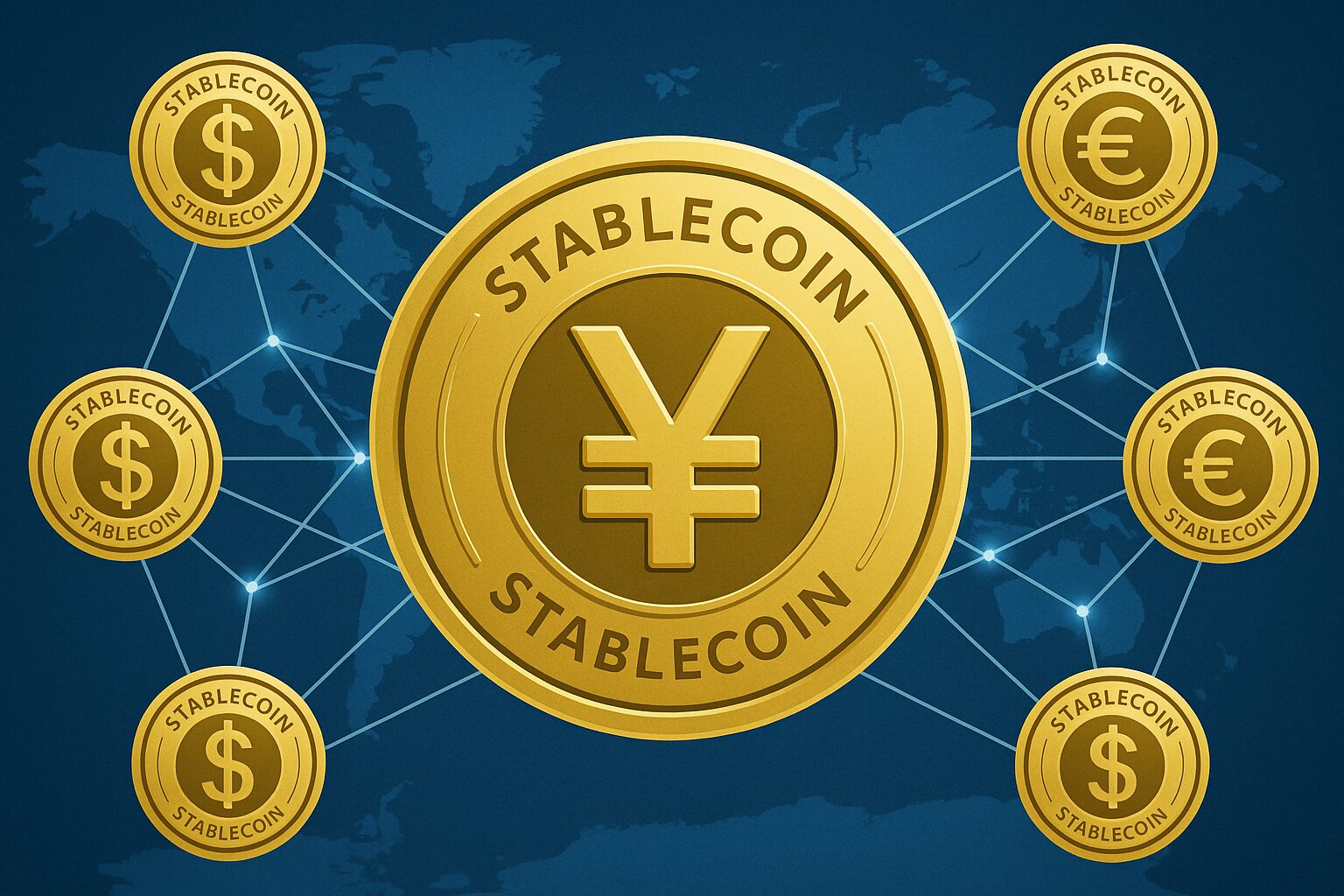
#3 JPYC (JPYC Inc.): Japan yen-pegged stablecoin for seamless JPY transactions. Liquidity: Growing on Polygon and Japanese exchanges. Regulatory status: Licensed in Japan, compliant with local laws. Diversification benefits: JPY exposure offers Asian currency hedge post-China crackdown.
-

#4 GYEN (GMO Trust): Regulated JPY stablecoin issued by GMO Trust. Liquidity: Available on major chains and platforms like Bitfinex. Regulatory status: Approved by Japan’s FSA. Diversification benefits: Stable JPY backing enhances portfolio balance against CNY restrictions.
-

#5 EURe (Monerium): EU-regulated euro stablecoin with e-money license. Liquidity: Solid on Gnosis Chain and emerging DEXes. Regulatory status: EMI licensed in Europe. Diversification benefits: MiCA-aligned EUR asset for long-term 2026 compliance and risk mitigation.
EURC complements this with Circle’s institutional-grade backing. As the issuer of USDC, Circle brings MiFID II compliance and real-time attestations, ensuring euro parity even during Eurozone stress tests. For yield farmers, EURC’s integrations in Aave and Compound yield competitive APYs without the depeg anxieties plaguing lesser stables.
Shifting to yen-pegged options, JPYC emerges as a domestic powerhouse. Regulated under Japan’s Payment Services Act, it facilitates seamless remittances and merchant payments, boasting partnerships with Line Pay and Rakuten. In a yen carry trade unwind scenario, JPYC’s on-chain reserves provide a stable anchor, with liquidity pools exceeding 10 billion JPY equivalent.
GYEN, powered by GMO Trust’s banking infrastructure, adds another layer of credibility. Audited monthly and redeemable 1: 1 for physical yen, it appeals to conservative investors wary of crypto volatility. Its presence on centralized exchanges like Bitfinex ensures tight spreads, crucial for high-frequency strategies.
Monerium’s EURe rounds out the quintet with MiCA pre-compliance, a rarity in the stablecoin space. Issued on Ethereum and Polygon, it targets DeFi natives with programmable money features, like automated euro settlements. As EU regulations solidify, EURe positions portfolios for long-term growth in a borderless economy.
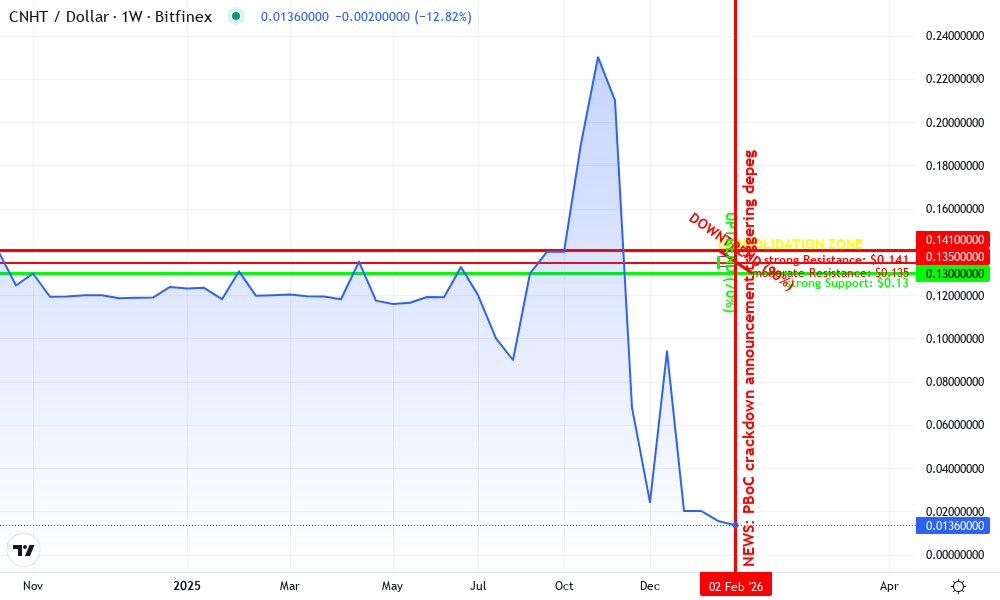
Tether CNH (CNHT) Technical Analysis Chart
Analysis by Lucas Trent | Symbol: BITFINEX:CNHTUSD | Interval: 1W | Drawings: 7
Technical Analysis Summary
As Lucas Trent, apply conservative markings: 1. Draw a primary downtrend line connecting the local high at 2026-01-28 (0.1410) to the breakdown low at 2026-02-10 (0.1300), extending forward. 2. Mark horizontal support at 0.1300 and resistance at 0.1410 with strong strength labels. 3. Add a vertical line at 2026-02-06 for the PBoC regulatory announcement. 4. Use callouts for volume spike on the drop and MACD bearish crossover. 5. Rectangle the consolidation zone from 2026-01-15 to 2026-02-05 between 0.1330-0.1380. 6. No entry zones marked due to low risk tolerance; focus on risk-off.
Risk Assessment: high
Analysis: Regulatory bans on yuan stablecoins erode peg credibility; technical breakdown aligns with fundamental risks in a low-tolerance portfolio.
Lucas Trent’s Recommendation: Avoid CNHTUSD entirely; reallocate to USD assets or bonds for sustainable returns.
Key Support & Resistance Levels
📈 Support Levels:
-
$0.13 – Recent lows post-crackdown, potential capitulation floor
strong -
$0.128 – Psychological extension if further pressure
weak
📉 Resistance Levels:
-
$0.135 – Mid-range retracement level
moderate -
$0.141 – Recent swing high, regulatory overhang
strong
Trading Zones (low risk tolerance)
🎯 Entry Zones:
-
$0.13 – Test of strong support, but only for scalps given fundamentals
high risk
🚪 Exit Zones:
-
$0.135 – Initial resistance test
💰 profit target -
$0.128 – Break of support invalidates
🛡️ stop loss
Technical Indicators Analysis
📊 Volume Analysis:
Pattern: Spike on downside breakdown
Elevated volume confirms selling pressure during depeg
📈 MACD Analysis:
Signal: Bearish crossover
MACD line crossed below signal amid drop, momentum shift
Applied TradingView Drawing Utilities
This chart analysis utilizes the following professional drawing tools:
Disclaimer: This technical analysis by Lucas Trent is for educational purposes only and should not be considered as financial advice.
Trading involves risk, and you should always do your own research before making investment decisions.
Past performance does not guarantee future results. The analysis reflects the author’s personal methodology and risk tolerance (low).
Joint liability in China’s notice extends caution to global players; exchanges listing unapproved CNY pairs risk blacklisting. By contrast, our top picks operate in jurisdictions prioritizing innovation within bounds. Liquidity metrics further differentiate: EURT and EURC dominate DEX volumes, while JPYC and GYEN excel in CEX yen corridors.
Portfolio Construction Strategies for 2026
Integrating these into portfolios demands strategy. Allocate 10-20% to non-USD stables for diversification, balancing with USD anchors. For instance, pair EURT with JPYC in a 60/40 euro-yen basket to hedge USD strength. Use historical CNY stablecoin trajectories as a cautionary blueprint: pivot early to regulated alternatives.
Layer in yield optimization via lending protocols, where EURC often outperforms at 4-6% APY. Monitor on-chain metrics like total value locked (TVL); as of February 2026, combined TVL for these assets surpasses $2 billion, signaling maturation. For high-net-worth clients, OTC desks now offer prime brokerage for GYEN and EURe, minimizing slippage.
Tax implications vary: EURe’s MiCA status may qualify for favorable treatment in Europe, while JPYC aligns with Japan’s crypto tax reforms. Always consult local advisors, as non-USD stablecoins 2026 evolve amid global scrutiny.
China’s China offshore stablecoins ban closes one door but illuminates others. By embracing EUR and JPY stables, investors not only mitigate immediate risks but cultivate resilience against future shocks. My long-held belief endures: true alpha accrues to those who anticipate regulatory tides, positioning portfolios for sustained compounding in a multipolar crypto landscape.