
Identify your jurisdictional rules
Stablecoin compliance begins with a single question: where is your issuer domiciled, and who are you serving? The regulatory path diverges sharply depending on these two factors. Issuers targeting US consumers face the new federal framework, while those operating in Europe must comply with the Markets in Crypto-Assets Regulation (MiCA). Other jurisdictions may impose local licensing requirements that restrict or prohibit issuance entirely.
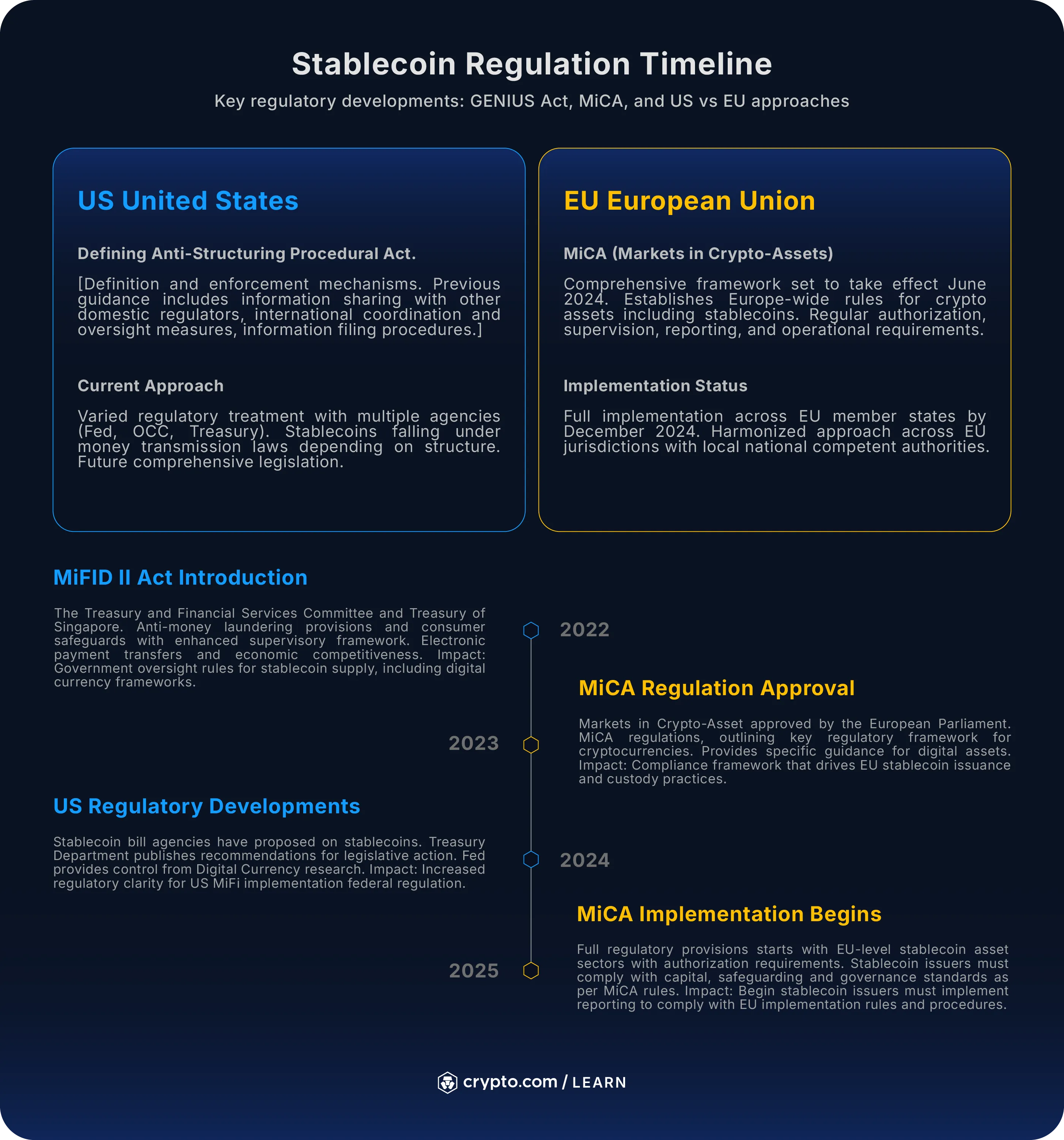
United States: The GENIUS Act
The Guiding and Establishing National Innovation for US Stablecoins (GENIUS) Act established the first federal framework for payment stablecoins. Enacted in July 2025, the law directs the Treasury Department and federal banking regulators to implement specific rules. Issuers must be licensed banks, thrifts, or money services businesses under state law.
The Treasury released proposed rules in early 2026 detailing reserve asset requirements. These rules specify where and how OCC-regulated permitted issuers may hold reserves. Compliance requires rigorous auditing and transparent reporting to the Federal Reserve and Treasury. Issuers should monitor the Federal Register for final rule adoption, as the proposed framework may shift before enforcement begins.
European Union: MiCA
For issuers operating in the EU, the Markets in Crypto-Assets Regulation (MiCA) provides a unified license. MiCA distinguishes between asset-referenced tokens and e-money tokens, with payment stablecoins falling under the stricter e-money token category. Issuers must obtain authorization from a national competent authority in an EU member state.
MiCA mandates strict reserve backing, regular audits, and consumer protection measures. Issuers must maintain adequate capital buffers and ensure smooth redemption processes. The regulation applies to any issuer offering stablecoins to EU residents, regardless of where the issuer is headquartered. Non-compliance can result in significant fines and operational bans across the bloc.
Other Jurisdictions
Many countries have not yet adopted comprehensive stablecoin laws. Some, like China, have banned private stablecoin issuance entirely. Others, such as Singapore and Switzerland, have introduced licensing regimes for payment token providers. Issuers must consult local legal counsel to determine if their target market requires specific approvals or prohibits the activity altogether.
Start by mapping your issuer’s legal entity location and primary user base. This determines whether you follow US federal guidelines, EU MiCA standards, or local requirements. Misidentifying your jurisdiction is the most common compliance error, leading to unnecessary costs or legal exposure.
Structure reserve assets correctly
To comply with the GENIUS Act, issuers must segregate reserve assets from operational funds and hold them in approved custodial arrangements. The Office of the Comptroller of the Currency (OCC) requires that permitted payment stablecoin issuers maintain reserves in a manner that ensures immediate liquidity and strict transparency. This structure protects consumers by guaranteeing that every token in circulation is backed by high-quality, low-risk assets that can be redeemed at par.
Establish separate bank accounts or custodial wallets specifically for reserve assets. These accounts must be legally distinct from the issuer’s operating accounts to prevent commingling. The OCC mandates that these funds are held solely for the benefit of stablecoin holders, ensuring they are immune to the issuer’s general creditor claims in the event of insolvency.
Limit reserve holdings to cash and U.S. Treasury securities with maturities of 60 days or less. The GENIUS Act restricts eligible assets to those with minimal credit and market risk. Issuers must avoid complex financial instruments, corporate bonds, or private credit, which do not meet the high liquidity standards required for daily redemption obligations.

Engage an independent third-party auditor to verify reserve levels daily. Unlike quarterly reports, real-time attestation provides immediate proof that reserves match circulating supply. This process must be automated where possible to reduce human error and ensure that the published reserve data reflects the actual state of the segregated accounts at any given moment.

Use OCC-approved custodians for holding Treasury securities and digital assets. Custodians must meet strict capital and operational resilience standards. Issuers must retain full control over withdrawal instructions, ensuring that no third party can freeze or divert reserve assets without explicit legal authorization from the issuer’s authorized signatories.
Proper segregation of assets is the foundation of stablecoin trust. By adhering to these structural requirements, issuers demonstrate that their tokens are not speculative bets but reliable digital dollars. Failure to maintain these segregated structures can result in immediate regulatory action, including cease-and-desist orders or revocation of the issuer’s charter.
Implement redemption and AML controls
Compliance with the 2026 stablecoin regulations requires operational precision in two critical areas: timely redemption of stablecoin liabilities and strict adherence to anti-money laundering (AML) frameworks. Issuers must structure their internal workflows to meet the FDIC’s proposed rulemaking under the GENIUS Act, which mandates that Payment-Product Stablecoin Issuers (PPSIs) redeem stablecoins within two business days of a request.
This timeline is not a suggestion; it is a hard constraint on liquidity management. Issuers must maintain sufficient high-quality liquid assets (HQLA) to cover potential redemption spikes without disrupting other operations. Simultaneously, issuers are subject to the Bank Secrecy Act (BSA) and AML rules, requiring robust transaction monitoring and customer due diligence.
Follow these steps to build a compliant redemption and AML infrastructure.

Configure your treasury and payment systems to process redemption requests within 48 hours. This involves integrating with traditional banking rails to ensure fiat outflows match stablecoin burns. Test this workflow under stress conditions to verify that settlement times remain consistent during market volatility. The FDIC’s proposed rule explicitly targets this two-business-day window, making operational readiness a primary compliance checkpoint.

Implement automated screening tools that check every transaction against OFAC sanctions lists and monitor for suspicious activity patterns. Since issuers are now subject to BSA rules, you must maintain records of customer identities and transaction histories. This system should flag high-risk jurisdictions or unusual volume spikes for manual review before processing.

Verify daily that your reserve holdings are sufficient to cover all outstanding stablecoins plus a buffer for redemption surges. Use independent auditors to confirm that the HQLA ratio meets regulatory expectations. These audits should specifically test the ability to liquidate assets quickly enough to meet the two-business-day redemption mandate without incurring excessive losses.
Require verified identity documentation for all users, particularly for higher-value transactions. Align your KYC (Know Your Customer) procedures with BSA requirements to ensure you can identify the beneficial owners of stablecoin holdings. This step is foundational for effective AML compliance and helps prevent the use of stablecoins for illicit finance.
Checklist for redemption and AML readiness:
Audit reserves and report regularly
Compliance is not a one-time setup. It is an ongoing cycle of verification and disclosure. Issuers must prove that every token in circulation is backed by high-quality, liquid assets. Regulators expect this proof to be transparent, frequent, and independent.
Establish a reserve composition policy
Define exactly what assets back your stablecoin. Regulations generally require reserves to consist of cash or short-term government securities. Avoid illiquid assets or complex derivatives that could lose value during market stress. This policy should be written into your operating documents and reviewed by legal counsel.
Engage a qualified third-party auditor
Do not rely on internal accounting alone. Hire an independent, reputable audit firm to verify your reserve balances. The audit should confirm that the total value of reserves equals or exceeds the total supply of tokens in circulation. This external validation is the primary trust signal for regulators and users alike.
Schedule regular reporting cycles
Transparency requires consistency. Publish audit reports on a fixed schedule, such as monthly or quarterly. If your jurisdiction requires real-time or near-real-time proof, implement automated attestation tools that link on-chain supply to off-chain bank balances. Make these reports publicly accessible on your website.
Maintain audit trails and documentation
Keep detailed records of every reserve transaction. Regulators may request evidence of how funds are managed, stored, and protected. A clean, auditable trail demonstrates operational maturity and reduces the risk of regulatory penalties or license revocation.
Integrate compliance into your tech stack
Automate where possible. Use oracle services or API integrations to pull reserve data directly from custodial banks into your public dashboard. This reduces human error and ensures that the data reported to regulators matches what the public sees.
Review and update annually
Regulations evolve. What is compliant today may not be sufficient next year. Conduct an annual review of your reserve policy, audit scope, and reporting frequency. Adjust your processes to align with any new guidance from central banks or financial authorities.
Avoid common compliance mistakes
Compliance is not just about having a policy; it is about executing it without error. The most frequent violations stem from operational negligence rather than malicious intent. Issuers often stumble on three specific fronts: reserve segregation, redemption speed, and jurisdictional clarity.
Segregating reserve assets
Under the proposed GENIUS Act rules, reserve assets must be held in a manner that prevents commingling with the issuer’s operating capital. A common mistake is treating the reserve pool as a general liquidity buffer for day-to-day expenses. This violates the core requirement that reserves are solely for backing outstanding stablecoins. You must maintain distinct accounts and rigorous accounting trails that isolate these funds from operational risk.
Meeting redemption timelines
Another critical failure point is the redemption window. The FDIC’s proposed rule generally requires payment stablecoin issuers to redeem tokens within two business days. Issuers who rely on slow settlement rails or fail to have sufficient liquid assets on hand will breach this mandate. Ensure your treasury management systems are calibrated to meet this two-day window under normal and stressed market conditions.
Correct jurisdictional classification
Finally, many issuers misclassify their jurisdictional status, assuming a favorable regulatory environment where none exists. If your stablecoin is deemed a payment instrument in the U.S., it falls under strict OCC or FDIC oversight. Misclassifying your token as a utility or ignoring the geographic location of your users can lead to severe enforcement actions. Verify your legal status against the Federal Register’s proposed rules to ensure you are not operating in a regulatory blind spot.
Frequently asked questions about 2026 stablecoin regulations
Stablecoin compliance in 2026 hinges on two primary frameworks: the U.S. GENIUS Act and the European Union’s MiCA. Understanding how these laws intersect is essential for issuers operating across jurisdictions.
No comments yet. Be the first to share your thoughts!