The GENIUS Act Changes Stablecoin Issuance
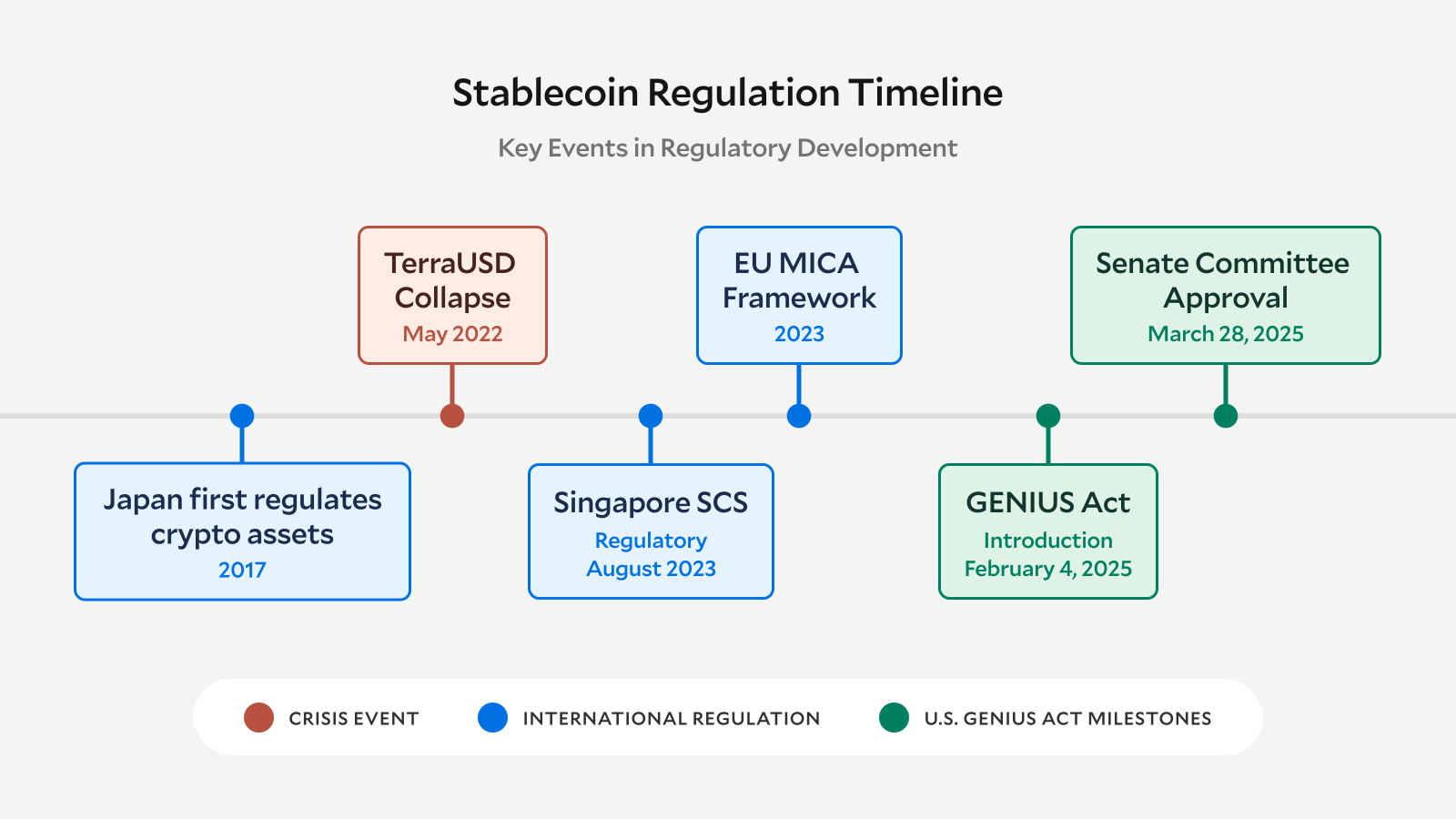
The GENIUS Act, enacted on July 18, 2025, establishes the first comprehensive federal regulatory framework for payment stablecoins. As outlined in the U.S. Treasury's proposed rules, the legislation mandates that issuers maintain reserves backing outstanding stablecoins on a strict one-to-one basis. These reserves are restricted to highly liquid, low-risk assets, primarily U.S. dollars, Federal Reserve notes, and funds held at regulated insured depository institutions [src-serp-1].
This legal structure fundamentally alters the market by shifting issuance authority from decentralized entities and private corporations to regulated banking institutions. The Office of the Comptroller of the Currency (OCC) has issued guidance clarifying that national banks and Federal Reserve Banks can now engage in stablecoin activities under this new framework [src-serp-5]. Consequently, the era of unbacked or loosely collateralized stablecoin models is effectively over, replaced by a system where traditional financial oversight governs digital payments.
The implications for monetary policy are significant. The Federal Reserve notes that this regulatory clarity supports the integration of stablecoins into the broader financial system while mitigating risks to payment stability and monetary sovereignty [src-serp-3]. By anchoring stablecoin issuance to traditional banking reserves, the GENIUS Act ensures that these digital assets remain tightly coupled with the U.S. dollar, preserving their function as a reliable medium of exchange rather than a speculative asset.
USDC vs USDT compliance in 2026
The GENIUS Act establishes a binary path for stablecoin issuers: comply with strict reserve and capital requirements or exit the U.S. market. Circle (USDC) and Tether (USDT) face different compliance trajectories due to their distinct corporate structures and reserve compositions. While both maintain one-to-one backing, the regulatory scrutiny now targets the quality of those assets and the transparency of the issuing entities.
| Feature | USDC (Circle) | USDT (Tether) |
|---|---|---|
| Issuer Structure | Circle, U.S.-based entity | Tether Limited, offshore entity |
| Reserve Composition | U.S. Treasuries, cash, deposits | Mixed: Treasuries, commercial paper, other assets |
| GENIUS Act Status | Aligned with proposed capital rules | Under scrutiny for reserve transparency |
| Regulatory Jurisdiction | Federal and state banking oversight | Limited U.S. regulatory oversight |
Circle’s U.S.-based structure positions it favorably under the new rules, which demand significant Tier 1 capital for large issuers. The Office of the Comptroller of the Currency (OCC) has noted that affiliated issuers responsible for over $50 billion in issuance must hold $2 billion in Tier 1 capital. Circle’s transparent reserve reports and reliance on short-term U.S. Treasuries align closely with the GENIUS Act’s requirement for high-quality, liquid assets. This alignment reduces regulatory friction and supports its adoption by institutional players seeking compliance certainty.
Tether’s offshore structure and mixed reserve assets present a more complex compliance picture. While Tether has increasingly shifted toward U.S. Treasuries, its historical reliance on commercial paper and other instruments draws scrutiny under the new law’s strict asset quality standards. The lack of direct U.S. regulatory oversight complicates enforcement and transparency, leaving Tether exposed to potential restrictions or mandatory restructuring to maintain U.S. market access.

The divergence in compliance readiness highlights a broader market shift. Institutional adoption is accelerating toward issuers that meet the new regulatory benchmarks, as seen in Rapyd’s 2026 report showing 64% of businesses using or planning to use stablecoins. This trend favors USDC’s transparent, U.S.-aligned model while pressuring USDT to adapt or face marginalization in regulated financial ecosystems.
Global Regulatory Divergence and RWA Tokenization
The passage of the GENIUS Act in the United States has created a regulatory gravity well, forcing other major jurisdictions to accelerate their own frameworks to remain competitive. The law’s strict definition of "payment stablecoins" and its mandate that issuers be regulated institutions—such as banks and credit unions—have effectively closed the door on unbacked or loosely regulated issuers in the US market. This clarity has immediate global ripple effects, as international financial centers scramble to align their rules to attract or retain capital.
In Europe, the Markets in Crypto-Assets (MiCA) regulation is already in full effect, providing a comprehensive but rigid framework for stablecoin issuers operating within the EU. Meanwhile, the UK is under significant pressure to finalize its own stablecoin regime. According to industry analysis, new global rules are reshaping payments and pressuring the UK to act quickly to avoid losing ground to US-based regulated entities that now have a clear legal pathway to operate [1]. This divergence creates a complex landscape where issuers must navigate multiple compliance standards, but it also drives the broader adoption of compliant digital assets.
A critical outcome of this regulatory push is the acceleration of Real World Asset (RWA) tokenization. The GENIUS Act’s reserve requirements—mandating that payment stablecoins be backed on a one-to-one basis by specified assets like US dollars or federal reserve notes—have increased institutional confidence in the underlying mechanics of stablecoins [2]. As issuers hold more high-quality liquid assets to meet these reserves, the line between traditional finance and tokenized assets blurs. This has spurred demand for tokenized treasuries and other RWAs, as the infrastructure for stablecoins increasingly overlaps with the infrastructure for tokenized real-world value.
The market is already responding to these structural shifts. Business adoption is moving en masse, with recent data showing that 64% of surveyed businesses either already use stablecoins or plan to within three years, driven by the need for speed and cost savings in cross-border transactions [3]. As regulatory clarity improves, the tokenization of RWAs is expected to move from experimental pilots to core treasury operations for many enterprises.
[1] https://thepaymentsassociation.org/article/how-stablecoin-regulation-is-reshaping-payments-in-2026/ [2] https://www.lw.com/en/insights/the-genius-act-of-2025-stablecoin-legislation-adopted-in-the-us [3] https://www.rapyd.net/company/news/press-releases/state-of-stablecoin/
Enterprise yield strategies under the GENIUS Act
Generating yield on stablecoin holdings has shifted from a DeFi gamble to a regulated treasury function. Under the GENIUS Act, enterprises can no longer rely on opaque lending protocols or unbacked yield aggregators. Instead, yield must be derived from permitted reserve assets and compliant on-chain structures. The Treasury Department and the OCC have made it clear that reserve assets must consist primarily of cash, U.S. Treasury securities, or other high-quality liquid assets. This constraint limits yield potential but eliminates the counterparty risk that plagued the 2022–2023 cycle.
| Asset Type | Yield Source | 2026 Status |
|---|---|---|
| U.S. Treasuries | Direct issuance yield | Permitted |
| Commercial Paper | Short-term debt | Restricted/Phasing out |
| DeFi Lending | Protocol fees | High scrutiny |
Enterprises must navigate these constraints carefully. The following steps outline how to structure stablecoin holdings for yield while maintaining full regulatory compliance.
The GENIUS Act mandates that payment stablecoin issuers maintain reserves on a one-to-one basis. For enterprises holding stablecoins, this means verifying that the underlying assets backing the tokens are U.S. dollars, Treasury bills, or funds held at regulated institutions. Avoid stablecoins that include commercial paper or private credit in their reserves, as these are being phased out or restricted under the new framework. Regular audits by independent firms are now a baseline requirement for any compliant issuer.

Once compliant stablecoins are identified, yield can be generated through permitted on-chain instruments. This typically involves lending compliant stablecoins to regulated financial institutions or participating in institutional-grade liquidity pools that are subject to Know Your Business (KYB) and Anti-Money Laundering (AML) checks. The OCC has signaled that banks can now offer stablecoin custody and yield services, creating a bridge between traditional finance and blockchain yield. Avoid unverified DeFi protocols that do not disclose their reserve composition or lending counterparties.
Compliance is not a one-time event but an ongoing process. Enterprises must implement robust transaction monitoring systems to track stablecoin movements and ensure they do not interact with sanctioned addresses or high-risk DeFi platforms. The DOTFILE compliance guide for 2026 emphasizes that KYB checks must be performed on all counterparties in the yield generation chain. This includes verifying the regulatory status of any lending platform or protocol involved in the yield strategy. Failure to maintain these records can result in significant penalties under the new enforcement guidelines.
The shift toward regulated yield is reshaping corporate treasury management. As seen in Rapyd’s 2026 State of Stablecoins report, 64% of businesses now use stablecoins or plan to within three years, driven by the need for speed and cost savings. However, the yield component is no longer an afterthought; it is a core compliance requirement. Enterprises that align their strategies with the GENIUS Act’s reserve rules will be better positioned to capture value without exposing themselves to regulatory risk.
Frequently Asked Questions About Stablecoin Rules
The regulatory landscape for digital assets shifted significantly in 2025 and 2026. The following questions address the core mechanics of the GENIUS Act and the current state of market adoption.
For detailed compliance guidance on KYB/KYC and transaction monitoring under the GENIUS Act, refer to the Federal Reserve's analysis on payment stablecoins.
No comments yet. Be the first to share your thoughts!